Three Embodied Practices
One of the core challenges I keep returning to while writing my portion of Embodying the Biology of Belief is this: how can I help unpack the science so it’s more understandable and, most importantly, build a bridge to a livable experience for the reader?
Bruce Lipton’s Biology of Belief changed how I understand cells, perception, and human potential. But understanding the science intellectually and actually living it—embodying it in my daily life—are two very different things.
Over the years, I’ve developed practices. Not complicated protocols or techniques that require special equipment or training. Just simple, accessible ways to drop out of my head and into my body. Ways to interrupt the mental loops and land in the present moment.
These practices aren’t things I do on a meditation cushion once a day and then forget about. They’re woven into the fabric of my regular life. They happen while I’m walking downtown, sitting in my car, or standing in my kitchen.
I never planned any of it, and I didn’t even know I was “doing” anything. But over time—and as Bruce teaches, through repetition—something happens to the nervous system. If that repetition keeps being nurtured, it naturally turns into a practice.
Recently, I became more aware of these practices and their implications. I was reaping the rewards of having more pleasant life experiences regularly by consciously choosing to create those moments.
Bottom line: these practices work, and my goal is that they inspire you in some way to create your own version.
Something magical happened at Big Ears Festival recently. It involves three embodied practices, and over the next three blog posts, I’d like to share how they all came together.
- 10/10 – A practice that started with my son’s birth and evolved into a daily reminder to pause, feel, and return to what matters.
- Bookmarking – How to consciously lock in moments of joy and access them anytime, creating your own library of cellular nourishment.
- Just Feel How Good Everything Is Right Now – Eight words that arrived like a transmission and became a practice for letting go when life feels tight.
Each practice is different. Each came from a specific moment in my life. But they all share something in common: they help me access the 500 million years of cellular wisdom already living in my body.
Because our cells know things our minds don’t. They’ve been adapting, learning, and evolving since long before we were born. The question isn’t whether that wisdom exists—it’s how to access it consciously, playfully, and in the ordinary moments of our lives.
These three practices are my answer to that question.
They’re offerings. Invitations. Starting points.
Try them. Adapt them. Let them spark your own embodied practices.
Because the real work of embodying the biology of belief isn’t about memorizing concepts—it’s about finding simple, sustainable ways to live from your body’s intelligence instead of just your mind’s stories.
Let’s begin with the first in our series of three.
10/10 Embodied Practice
One of the core challenges my co-author and I keep returning to while writing our book is this: how do we make the science livable? How do we take what can quickly become heavy material and bring it down to earth — to the level of a curious elementary schooler, or better yet, to the level of your daily life?
That’s the real work. Because our cells have been learning to adapt to life on this planet for over 500 million years. That wisdom is already in you. The question is how to access it — consciously, playfully, and in the ordinary moments of your day.
Which brings me to my 10/10 practice.
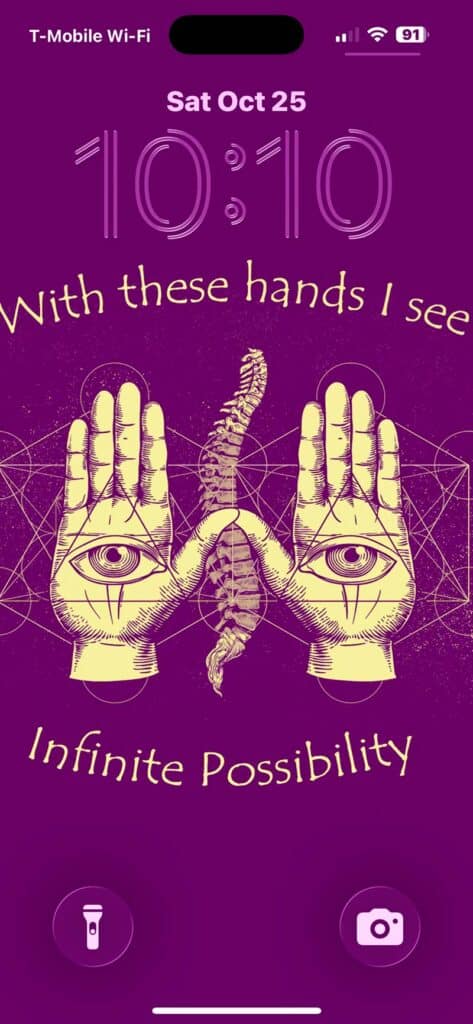
It started with my son Noam, born at home in our quiet, woodsy place in Santa Cruz on October 10, 2009, at 10:47pm on a peaceful early fall evening. I was rooting for 10/10 all day. My wife Laura was feeling it too — she was all in. Let’s get this baby out. She’s my forever unsung hero.
With under an hour and a half before October 11 crept in, I remember that quiet intensity — not attached to the outcome, just strongly feeling that there was something about 10/10 and this child.
The following morning — Noam’s first morning home — I stumbled into the kitchen and glanced at the oven clock the way you do without thinking. It read 10:10. I smiled. Made the connection. Thought of him, this newborn barely 12 hours into the world, and felt my heart fill up completely.
And then it kept happening.
Walking into a room, glancing at my phone, opening my laptop — 10:10 would just be there. Morning, evening, sometimes both. It became undeniable. And every single time, it gave me a pause — a breath, a thought of Noam, of our family, of those moments leading up to a magical homebirth experience, palpable feelings of connection, love and the grand mystery of this lived experience. A whole universe of these feelings compressed into a single instant of awareness.
And that’s what 10/10 keeps pointing me towards when I see it.
That’s my personal reference of an embodied practice. There’s a felt sense when it happens that matches no other. It’s embedded in my connective tissue.
Not complicated. Not requiring a meditation cushion or a wellness retreat. Just a cue — a moment that your nervous system learns to recognize — that pulls you out of autopilot and into presence.
Your cells respond to that. Every time.
And it keeps evolving. Noam is sixteen now, so this has been going on for years. The practice became its own form of autopilot. Then something new emerged: in the past year, 9:29 started showing up. It appeared across my devices and at home on the famous oven clock, slightly before bed, or just before leaving for work on most days.
September 29 is my birthday — a self-reflected pause for the cause. An acknowledgment to my higher self that I’m doing the best I can and I will continue to. A moment of an inner smile and a personal hug for all that I am.
So now both numbers appear with an undeniable regularity that I can’t explain and don’t need to. (There are quite a few more “times in forms of birthdays” that I notice and show up for me, but no need to be redundant here.)
So, every time I see 9:29, the same thing happens—I pause, I smile, I feel it in my deep belly, and somewhere in that moment I hear “I love you” — and then consciously respond, “I love you more!”
Just writing that made me smile. And that’s exactly the point — that’s exactly how it feels in the body when it happens.
My cellular democracy receiving these messages repeatedly does something. Repetition creates neural pathways, yes, but it also signals safety, belonging, worthiness at the cellular level. That extra something feels energizing, feels healthy, feels vital.
The beat has been waiting for your arrival and for you to notice it. And it is strongly passionate about helping you show up fully for your life.
I’d love to hear: do you have a moment like this in your own life? A number, a song, a smell that stops you and brings you back. What’s your 10/10?
You may already be practicing without “knowing” it.
——————————————————————-
The Gap Between Knowing and Living
I can explain cellular biology. I can teach you about epigenetics, the role of perception in gene expression, and how beliefs literally reshape your biochemistry.
But here’s what I’ve learned after 25 years of developing these organically grown practices: understanding something intellectually doesn’t mean you’re living it or getting any value out of what you know, for that matter.
That gap—between knowing and embodying—is where most of us get stuck. And a big part of that stuckness is due to cultural beliefs that we need to unpack. (Hint: Bruce’s four myth-perceptions in his book directly point to this, and we’ll have practices for each myth in our upcoming book.)
Bruce Lipton’s work opened my eyes to how powerful our biology is, especially when we engage with it. But the real transformation didn’t come from reading about it. It came from finding simple, daily practices that helped me access that cellular intelligence in real time.
Not during formal meditation sessions. Not in workshops or retreats. In my actual life. While walking to my car. Standing in line at the grocery store. Lying in bed before sleep.
In my last post, I shared the embodied practice that started 16 years ago when my son was born:
10:10 Embodied Practice – how a number became a doorway back to presence and love.
In this second installment, I’d like to tell you about a practice that started back in 2019:
Bookmarking – The practice of consciously storing moments in your hard drive so your nervous system can access them anytime.
Remember, these aren’t complicated techniques. They don’t require equipment, training, or extra time carved out of your day.
They’re just ways to drop from your head into your body. To interrupt the mental noise and land in the moment. To access the wisdom that’s already there.
Your cells have been adapting to life on this planet for over 500 million years. That intelligence is in you right now. These practices are simply ways to listen.
Try them. See what resonates. Let them become your own.
Because embodying the biology of belief isn’t about perfect execution—it’s about finding your way home to your body, again and again, in the small moments that make up a life. And that all translates to an embodied cellular consciousness that is your best biofuel.
The Bookmarking Practice
This one started on a camping trip with five of my closest friends to an incredible spot in Arroyo Seco, California.
It was a three-day expedition — seven hours of hiking through some of the most treacherous terrain I’ve ever encountered, including traversing waterfalls, to reach our destination deep in a massive canyon: a place known as the Mother Pool. Best experienced in early spring when the waters are running full and alive.
Inside that canyon is a stretch of connected pools joined by gentle waterfalls, making it easy to drift upstream or downstream and explore. Completely remote. No noise from the outside world. Just my tribe and that place.
It was there, slipping in and out of pure bliss, that I became aware I could bookmark the moment — consciously lock it in — so I could return to it anytime and receive the same value from it as if it were happening right now.
I can feel the peak of whatever moment, breathe into it, feel the ground beneath me, and bookmark it, like I do with a good read where I mark the special places I want to return to later.
The cool thing? This works.
Even right now, writing this, I can feel myself back in that canyon. Held perfectly by a rock shaped like a natural La-Z-Boy. Feet resting in the cool running stream between two pools. Face turned toward the hot sun. A perfect breeze caressing my body, feeling nestled in Nature’s arms.
I can feel it. And feeling it makes me feel good. Which means I’m actively doing something right now that benefits my health and well-being — simply by choosing to tune into a memory that brings me joy, ease, and peace.
Now, if I add the sense of ‘feeling safe’ to this moment, it boosts the value of my physiological reset. My autonomic system gets the signal that things are good, there’s no threat happening here.
That’s the practice. Conscious. Simple. Available to you anywhere, anytime.
Because no matter how much chaos looms in the world, there is always the eye of the storm — and you can choose to live there.
Even, and most importantly, just for a moment – because these moments add up. If at the end of each day we tallied up the “safety in me” cues (SIMs) and the “danger in me” cues (DIMs) and we can get to a threshold that’s just a little more okay than not, we would lead a more salutogenic life (vs. pathogenic).
Another way to think of it: if 51% of my daily lived experience is feeling okay/at ease/overall well and 49% is being triggered/defensive/feeling unsafe, that would still tally up to a healthy overall physiology – the soil needed for living a good, happy life.
Obviously with continued practice and awareness we want to widen the gap between our DIMs and SIMs. The more time we spend in SIMs, the more we support a healthy, relaxed and resilient bodymind designed to be the best version of itself, with all its uniqueness and gifts to share in community.
Making the Invisible Visible
There’s a question I ask in almost every workshop I teach: “How do we make the invisible visible?” Another way of asking this is: “How do we become aware of the fact that we are both energy (invisible) and structure (visible)?”
Why is this relevant? (Bruce would ask about now!) Because seeing and feeling the world as both sides of the same coin—energy and matter—is empowering, adds magic to the moment, and can help shift us out of unpleasant physiological states that don’t match the moment we’re attempting to experience.
So, how do we take concepts like cellular consciousness, epigenetics, and the biology of belief—ideas that live in the realm of science and theory—and bring them down to earth? Down to the level of your actual, lived experience?
Not just something you understand. Something you feel.
That’s the work. And it’s trickier than it sounds. But it also adds a certain spice to life you can’t buy or find at any international flea market anywhere.
I spent years studying Bruce Lipton’s research and notes, years before his first book arrived on the scene. I remember being fascinated by how perception changes biology, how beliefs literally reprogram cells, how we’re not victims of our genes but participants in our own evolution.
Beautiful science. Life-changing insights. Where is the bridge and how can I get there?
The real shift happened when I stopped just thinking about it and started practicing it. When I found simple ways to access that cellular wisdom in the middle of my ordinary, messy, beautiful life.
In my last two posts, I’ve shared two practices that do exactly that:
10/10 – a practice born from my son’s birth that evolved into a daily pause for presence, and
Bookmarking – a practice to capture moments of joy and carry them with you as cellular nourishment.
For the third installment in this blog series, let me tell you the recent story of:
Just Feel How Good Everything Is Right Now – Eight words that arrived when I needed them for comfort and perspective—and have now become a simple and grounded way back to gratitude.
None of these require special skills or circumstances. They’re not reserved for meditation cushions or quiet retreats.
They happen in parking lots, at kitchen tables, during walks through the neighborhood. They’re woven into regular life because that’s where embodiment actually lives—not in the concept, but in the moment.
Your body already knows things your mind is still trying to figure out. These practices are just ways to listen. Ways to make the invisible visible. Ways to live from your cellular intelligence instead of just thinking about it.
Read them. Try them. Adapt them to your own life.
Because the biology of belief isn’t something to study—it’s something to embody.
And it starts right here, right now, in the simple practice of paying attention.
Just Feel How Good Everything Is Right Now
Just feel
how good
everything is
right now.
Eight words. Four beats. And they stopped me in my tracks — literally.
I heard them recently in a very rhythmic way, and they’ve become a new practice for moments when I feel uptight about something I can’t control. Learning to let go and trust the moment has been an ongoing inquiry for me. These eight words arrived like a transmission — what I’ve been describing to friends as getting “slapped by my higher self.”
It happened last weekend at Big Ears Festival in Knoxville, Tennessee. Four days of world-class musicians across multiple stages and venues throughout downtown. I went in without rigid expectations, having been warned by seasoned festivalgoers that you’ll inevitably miss something you wanted to see. I heard them — I just didn’t think it would happen to me.
I’m structured. I know what I want.
And yet. The show I most coveted had a line out the door and around the block. I sat with that for a moment — how did I end up late to the one show I absolutely had to see? No answer came. None was needed.
I started the two-mile walk back across downtown to catch SML, one of my new favorite jazz crossover bands in residency at the festival — a group I’d already seen perform four sets and would happily see again.
Somewhere along that walk, I just… stopped. Mid-stride, good pace, no reason. And that’s when I heard it:
Just feel / how good / everything is / right now.
In that moment, everything snapped into focus. In the grand scheme of things, everything was perfect. I was having the time of my life. There was still so much incredible music ahead. I had everything I needed — and most importantly, I had great energy and stamina, which allowed me to be with the music in deeply intimate ways. To dance, to sway, to go still — whatever the moment was inviting. I made new connections, met musicians I deeply respect, and kept running into friends from Asheville, including a few people I knew all the way back from Santa Cruz.
Nothing was missing. Everything was exactly right.
Now these eight words live in my back pocket. In moments of tightness, I can pause, say them in rhythm, and let that cellular memory of Big Ears move through me — instant comfort, instant nourishment, instant return to what’s true.
I’m challenging myself, in a very kind way, to become aware of those moments when I find myself moving in rigid ways or patterns that are customary, that I know well, when my buttons get pushed just right.
I have a new pause.
These eight words, at the rhythm of the moment they’re calling, are going to patiently wait for a response. A response to find gratitude in the gift of aliveness.
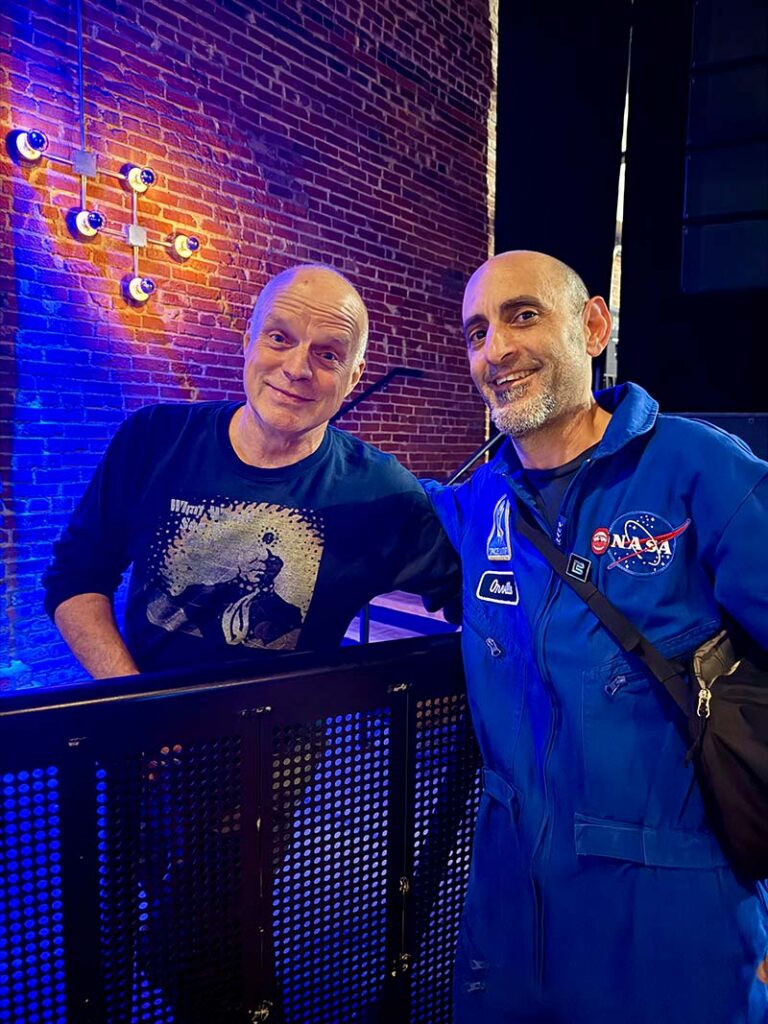
So here I was, at my first Big Ears Festival right in the middle of all the action listening to one of my favorite new jazz bands on the scene, SML. The fourth and final night and they start playing “Taking Out the Trash,” one of my favorite tracks off their new album — which reminds me of dumping those old beliefs I don’t need to carry any longer.
I look at my phone to coordinate with my buddy Jeff and notice it’s 9:29pm. I offer all my cells a loving inner-smile, bookmark the moment, and recite…
Just feel / how good / everything is / right now.
I offer it to you.